Lessons in Emergence: The History of Rage Against the Machine's Evil Empire
There are no new ideas. There are only ways of making them felt. - Audre Lorde

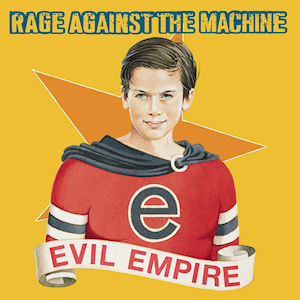
Rage Against the Machine released their sophomore album ‘Evil Empire’ on April 16, 1996, through Epic Records. Named after a hypocrisy-filled phrase Ronald Regan used to describe the U.S.S.R, ‘Evil Empire’ followed the radical theme of their debut. RATM’s sophomore album was released four years after the first album, a very long time by music history standards. What transpired was a record detailed in history, left-deep in politics, and driven by urgency. It didn’t come easy, like anything worth its weight in leftist ideals. Personal and professional differences stalled recording, and some say, almost ended the band altogether. The sound of ‘Evil Empire’ is embedded with a spirit that can only be accomplished by a group that has worked their disagreements out for a more significant cause. With Brendan O’Brien at the production helm, and the band’s talent up front, Evil Empire went three times platinum in the United States. But it is more than that; it is a lesson in emergence.
Wanting to keep the momentum going from their self-titled debut, they started creating quickly after a three-year tour following their first album’s success. With Zach De la Rocha’s fiery vocals, Tom Morello’s funky hard guitars, Tim Commerford’s (Tim Bob) passionate bass, and Brad Wilk’s intense drumming, ‘Evil Empire’ was stacked from the start. Unfortunately, with talent and a deep sense of integrity in getting their message across, RATM struggled to keep it together during the early part of recording during the Atlanta sessions. Jumping into the studio right after extensive touring didn’t solve their ongoing issues; according to Wilk, “we go into rehearsal to make a second record, and all the personal differences that we had swept under the rug when we were touring suddenly came up, and we had to deal with them. I felt like the band could’ve fallen apart then.” The band dropped the studio, feeling as if the space itself was uninspiring; De la Rocha added, ‘we weren’t going to go in and play in a studio that just had no environment whatsoever. You get in some of those places, and it’s like you’re walking into a dentist’s office.” RATM took a break, took a breath, and reassembled at Cole Rehearsal Studios in Los Angeles. When asked about the hold-up, Tom Morello added “Different band members have their different interests that they’ve been pursuing, but principally, the main reason for the delay between records was trying to find the right combination of our very diverse influences that would make a record that we were all happy with and that was great. That was a long process.” From the start, this album displayed meaningful collaboration in action, which rarely comes easy.
History is in the details, and RATM didn’t skimp on them. Rap is an excellent tool for getting as much of your message in a song as possible, and lead singer Zach De la Rocha raps with linguistic skill and wit. He’s abrupt, self-assured, and explosively clear. His delivery encourages audience unity, like a revolutionary choir. The songwriting on ‘Evil Empire’ isn’t open to interpretation, nor is it vague enough to land on any campaign. Instead, it is explicitly radical and rooted in the left. The theme is found in the very first sentence of the album; De la Rocha says, “yeah, people come, up,” a call out to the oppressed, those fighting for their rights, specifically in ‘People of the Sun’, to the Zapatistas. A group that is fighting for the land and life of indigenous people in Mexico, against NAFTA, Capitalism, and Neo liberalism. De la Rocha raps Check it; since 1516, minds attacked and overseen/Now crawl amidst the ruins of this empty dream/With their borders and boots, on top of us /Pullin’ knobs on the floor, of their toxic metropolis. In ‘Bulls on Parade’, they confront the U.S. military as well as the corporate footmen that back it with lyrics like “weapons, not food, not homes, not shoes, not need, just feed the war cannibal-animal,” and “What we don’t know keeps the contracts alive and movin.”
This first track sets up another theme on the album, the endurance needed to rebound when fighting for justice; when De la Rocha shouts, it’s coming back around again at the top of the chorus. The rebound comes up again in ‘Year of tha Boomerang’ with themes of colonialism, and oppression, and ‘Tire Me’ with the lyrics Yeah, ya tryin’ ta tire me, tire me /I can see you in front of me, front of me/Ya tryin’ ta tire me, tire me/Why don’t you get from in front of me? It is a track that celebrates the death of war criminal Richard Nixon and attempts to bring some reality back to the mess his eulogies tried to cover up. One thing people actively fighting for justice often face is burnout, and coming back around is an art. In ‘Evil Empire’, RATM gave us a time and place and descriptive visuals that guide us through history. Not only do they write meaning into their lyrics, but they also provide us with reason.
The difference between their first album and this one is that even after the tension, they sound more cohesive. The sound doesn’t fight with De la Rocha’s voice; it is fighting for it, alongside it. The sound is quick, explosive, and insistent, but it gives him the space to clearly say what is necessary. There is an apparent momentum in the music that one can feel physically. It is a powerful combination of political lyrics with an audible sense of urgency. Morello turns the guitar into a turntable in ‘Bulls on Parade’ by using two pickups and rubbing his hands on the strings, stating that he wanted a “menacing” sound. With elements of hip-hop, funk, rock, and metal, RATM perfected their technique on ‘Evil Empire’, making it impossible not to move your mind and body after hitting play.
Some of the most powerful aspects of this album aren’t just in the songs; they’re in the stories, actions, and the album booklet. De la Rocha went to Chiapas to visit the Zapatistas, the band participated in the Radio Free Los Angeles performance that brought activists and artists from many backgrounds under the banner of voting and justice, and their refusal to back down to NBC officials over their performance. The ‘Evil Empire’ CD booklet had a reading list for radicals with everyone from Karl Marx to James Baldwin. RATM acted in and pulled from culture, engaging in theory and praxis. This album is evidence of their understanding that big change comes from small changes, and working together as a whole. In her book about connection and social justice, Emergent Strategy: Shaping Change, Changing Worlds, Adrienne Maree Brown writes about collaboration in that “there is an art to flocking: staying separate enough not to crowd each other, aligned enough to maintain a shared direction, and cohesive enough to always move towards each other.” Rage Against the Machine seems to have done this not only on ‘Evil Empire’ but in their ability to bring their band together and tour for massive audiences twenty-six years later. It’s coming back around again.
References: Childers, Chad. (April 16, 2022) 26 Years Ago: Rage Against the Machine Release ‘Evil Empire’ | https://loudwire.com/rage-against-the-machine-evil-empire-anniversary/? utm_source=tsmclip&utm_medium=referral Retrieved: August 20, 2022.
Emergent Strategy: Shaping Change, Changing Worlds (AK Press, 2017) ISBN 9781849352604 Irwin, Cory. (April 16, 2021).
How ‘Evil Empire’ Nearly Ended Rage Against the Machine https://ultimateclassicrock.com/rage-against-the-machine-evil-empire/ Retrieved August 16, 2022.
“Tom Morello Guitar Lessons 03 Bulls On Parade”. Archived from the original on December 21, 2021 – via YouTube. Dean, Robert. (April 16, 2021).
Rage Against the Machine’s Evil Empire Still Burns with Indignation 25 Years Later. https://consequence.net/2021/04/rage-against-the-machine-evil-empire-editorial/ Retrieved August 20, 2022.
Deep(er) Transformation: (Re)Building and Sustaining Villages that heal. https://www.deepcenter.org/2020/10/14/deeper-transformation-rebuilding-and-sustaining-villages-that heal/ Audre Lorde Quote.
MTV News Staff. (January 22, 1996). Evil Empire Due From Rage Against The Machine - MTV. https://www.mtv.com/news/506885/evil-empire-due-from-rage-against-the-machine/ Hilburn, Robert. (April 14 1996).
Up Against the Wall - Los Angeles Times. https://www.latimes.com/archives/la-xpm-1996-04-14-ca-58271-story.html